Unknown's avatar

About practicallyspeakingwithbrita

I have been a licensed Marriage and Family Therapist for over 10 years in both California and Utah. I graduated from BYU with a bachelors degree in Marriage, Family and Human Development and went on to complete my masters degree in Marital Therapy from Loma Linda University. In addition to the privilege of working with individuals, couples, and families, I also have enjoyed teaching parenting and anger management classes and was a Clinic Manager before I placed my license on inactive status as I focused full time on being a wife and a mother to my husband and our four kids. I have been a speaker at various functions and conferences and enjoy being able to assist others where I can. You can also find me happy in my kitchen assisting myself to chocolate chip cookie dough.

Truth or Myth? Many Marital Arguments Cannot Be Resolved.

Truth! The truth is that all couples have perpetual problems that do not get solved. In fact, according to renowned researcher, John Gottman, PhD, nearly 2/3 of relationship problems are unsolvable(69%).

Dan Wile, PhD, developer of Collaborative Couple Therapy, noted that, “When choosing a long-term partner, you will inevitably be choosing a particular set of unsolvable problems.” These unsolvable problems are also known as perpetual differences in the mental health world and all couples will have perpetual problems. These issues center on fundamental differences in personality or differences in your own backgrounds which is where your belief system is derived. For instance, one spouse might be more extroverted while the other is more introverted. One partner might be more careful with spending having endured tight financial circumstances while they grew up while the other has a more free spending attitude due to emotional experiences associated with gift giving. One partner might value cleanliness and order more and place a higher value on neatness than their spouse who grew up differently and feels suffocated by their partner’s insistence on the house looking pristine. These differences which lead to perpetual problems or where the mountains collide can become an effective tool to bring you closer together as a couple or the wedge that can lead to emotional distance and gridlock.

The key to managing unsolvable problems is to establish a dialogue about the perpetual problem. It is not the presence of the conflict that stresses the relationship, it is the manner in which the couple responds. Be willing to discuss issues and know that your job is not to solve the conflict but to understand where your spouse is coming from. Most conflicts are not about the issue itself but underneath are about “Where are you, Do I matter to you, Are you there for me- Can I count on you first to respond to me- to put me first? Not having a way of discussion often leads to what therapists deam dialogue gridlock. Unaddressed gridlock eventually leads to emotional disengagement. The one thing that love can’t survive is constant emotional disconnection. Conflict is often less dangerous for your relationship than distance. Positive, respectful communication about differences helps keep a marriage thriving.

Seek to understand the meaning of your spouse’s positions. What is it that matters to them about that particular issue. For example, your partner’s fixation on not being late to an event can be easier for you to understand realizing that growing up being on time was emphasized as a way to show respect and that they feel upset that they are being disrespectful and feel shame and embarrassment when they walk in late. Instead of trying to change how they feel and that they shouldn’t feel shame, or embarrassment, seek to understand and accept that it matters to them and you can make it matter to you as well because you love them. Seeking to accept and appreciate your spouses differences rather than impose your beliefs (no matter how right we feel!) on how they should act, strengthens your bond in a way that nothing else can. To love someone is to accept that person exactly the way he or she is right now, knowing you both have weaknesses but working together, you become stronger.

Developing a shared meaning is a crucial step in creating the marriage that you really want. All of us come into marriage with preconceived notions and definitions for how we view things. We are meant to be different and these differences when combined often can lead to happier endings. Even now if you were to ask your spouse to define “home” or “love” you would find that you do not have the exact same definition. Shared meaning is where building on your unique views, you build something together. Rituals–daily, weekly or monthly is the avenue that helps to build this new shared life that the two of you are creating. Rituals around leaving and returning with a kiss or the special way you end a phone conversation to weekly dates that show that your partner values spending time with you or a monthly puzzle you put together. The rituals you create together will be as unique to your relationship as you are unique and will create the shared meaning which can alleviate the frustrations of merging ideas and focus on building the life you want together.

Beware what you are focusing on: Small things have a way of growing large when we dwell on them. There is a great story published in a magazine that I refer to as the parable of the toothpaste. One of the wife’s complaints was that her husband splashed toothpaste on the mirror when he would brush his teeth and never washed it off. It drove her absolutely crazy and she couldn’t let it go. The husband ended up passing away and the wife realized as the days past that even though her husband was no longer there, the toothpaste on the mirror remained. She realized that she contributed to the toothpaste on the mirror for years and the anger she felt towards her husband hurt her much more than it ever affected her husband. Choose to dwell on the positive qualities and attributes of your spouse instead of the “toothpaste on the mirror”. Overlook small things, be less critical and more forgiving.

This lesson about the great debate as to how the toilet paper should be hung was a lesson that I was taught a little over 25 years ago while I was visiting the house of one of my older brother’s friends. This couple was one that in my teenage view, was one of the ideal couples–you know the ones that seemed to dance around and make you wonder if they ever raised their voices because they seemed to talk in a sweet whisper at all times. This visit obviously left an impression on me as I can still remember it to this day. I had walked in on a discussion that was dire. I can remember being absolutely shocked to find out that there was a flaw in the fairytale that I had conjured in my mind. What could possibly cause so much duress to my real life couple version of Ken and Barbie? I quickly learned that the major disagreement I had walked into was about the way the toilet paper roll should be hung and they both had fierce arguments for their differing point of views. Could a roll of toilet paper really have such a huge impact? How was this conflict going to be solved? It turns out that for my Ken and Barbie couple they came up with the solution that it would be hung one way for the first 25 years of their marriage and the other for the next 25 years. I have been meaning to check back in with them and see if they really did switch after 25 years, but knowing that they realized their relationship is more important and how their spouse feels mattered more than the direction of the toilet paper gave me hope and meaning for the perpetual, unsolveable conflicts we all face in relationships.

Practically speaking,

Looking for more ways to deal with conflict? See the 7 Proven Tips to Handle Conflict.

7 Proven Tips To Handle Conflict

If there are no ups and downs in your life, it means you are dead. The truth is that no matter what, all relationships–whether they are with our family, coworkers, friends or spouses–will and should experience conflict simply as a fact of life. Resolving conflict is a necessary skill set for everyone. Here are some tips to help you handle conflict in your life.

Tip #1: Realize that Conflict is Normal and Necessary. In fact, Dr. John Gottman, PhD, who has been researching relationships for over 40 years, has found that it is not the presence of conflict that is damaging but the way in which conflict is handled. He found that the “Magic Ratio”: is 5-1. That means that for every negative interaction, happy couples will have 5 positive ones.

Tip #2: Take a Deep Breath. When a person’s heart rate reaches 100 beats per minute, they are unable to hear anything the other person says. By simply just breathing you allow necessary oxygen to slow down the amygdala which in turn “jump starts’ the prefrontal cortex or the side of your brain that comes up with the plans and problem solving and allow you to make more rational decisions.

Tip #3: Face each other when talking. Researchers found that simply maintaining eye contact made the biggest impact from changing a negative interaction to a positive one. Nonverbal behavior is the primary mode in which emotion is communicated. Facial expression, eye gaze, tone of voice, bodily motion, and the timing of responses are fundamental to emotional messages.

Tip #4: Mentally Recite Positive Attributes. All of us have a natural tendency to overemphasize the negative and underappreciate the positive. It is far easier to be critical than positive so amidst conflict, it can be helpful to remember positive attributes, characteristics or experiences that can balance and counter the at times overwhelming flood of negative emotions. For instance, upon finding a spouse’s is late, you can remember that they work hard to provide, are really good at playing games with the kids, picking shows to binge watch on Netflix or another experience that has made you smile in the past. Being grateful for the positive allows you to address conflict in a more realistic approach to the issue at hand instead of making mountains out of mole hills.

Tip #5: Use a Softened Start Up Approach. Gottman’s research has found that 96% of the time, the way a discussion begins can predict the way it will end. When one person begins the discussion with a harsh startup- being negative, accusatory or using contempt–the discussion is basically doomed to fail. On the other hand, when a person begins a discussion using a softened startup, the discussion will most likely end on the same positive tone. For Example:

Harsh Start Up :”You never have time for me!”

Softened Start Up: “I have been missing you lately.”

Tip #6: Limit criticizing and condemning language. What is it that you are hoping to achieve or what is it that you are wanting to communicate? Messages are often lost when language is critical or condemning: (“You always, or you never…”). Set ground rules in your relationship such as no name calling, no threatening divorce etc. and be cognizant of the the language that you are using. Language can be like the lighter fluid thrown on a smoldering fire- causing the fire to escalate out of control. Remember the goal is to face the challenge and work to put an end to the conflict rather than escalate it. Just because a thought goes through your head doesn’t mean it needs to come out of your mouth.

Tip #7: First seek to understand, then be understood. This golden rule of communication is key in being able to resolve conflict and promote change. Simply listening is a powerful tool in resolving conflict. “People start to heal the moment that they feel heard.” (Cheryl Richardson). Ask yourself, what is it that they want me to understand? When you get into a conflict, try and see the conflict as if you were a fly on the ceiling. Often, underneath the discussion of the conflict, someone is asking for more emotional connection. See if you can understand where they are coming from. “Never let a problem to be solved become more important than a person to be loved.”(Thomas S. Monson).

While conflict is a normal part of life, these tips can help you navigate and successfully handle the challenges you face together and strengthen your relationships. Practically speaking, share these tips with the ones you love and the ones you have the most conflict with 😉 and watch your ability to handle conflict improve!

Three Tips on Love From Mister Rogers {Including a One Minute Tip That Will Enhance Your Life}

For over 30 years, starting in 1968, Fred Rogers entertained and enlightened millions of viewers on his popular PBS television program, Mister Rogers’ Neighborhood. Even now, 50 years later, PBS still airs an animated show created and produced by the Fred Rogers productions called “Daniel Tiger’s Neighborhood.” The impact of Mister Rogers is undeniable and difficult to measure. Here are three tips from Mister Rogers specifically about love.

Tip #1: “You don’t ever have to do anything sensational for people to love you.”

This is a quote from Mister Roger’s commencement address at Dartmouth College in 2002. He was explaining the meaning behind a song from his popular PBS television program:
“It’s you I like.
It’s not the things you wear.
It’s not the way you do your hair
But it’s you I like.
The way you are right now
The way down deep inside you.
Not the things that hide you.
Not your caps and gowns,
They’re just beside you.
But it’s you I like.
Every part of you.
Your skin, your eyes, your feelings
Whether old or new.
I hope that you remember
Even when you’re feeling blue.
That it’s you I like,
It’s you, yourself
It’s you.
It’s you I like.”

Knowing that we are inherently loved–not because of anything that we have done or accomplished but simply because we are, is one of the most crucial concepts that we learn.

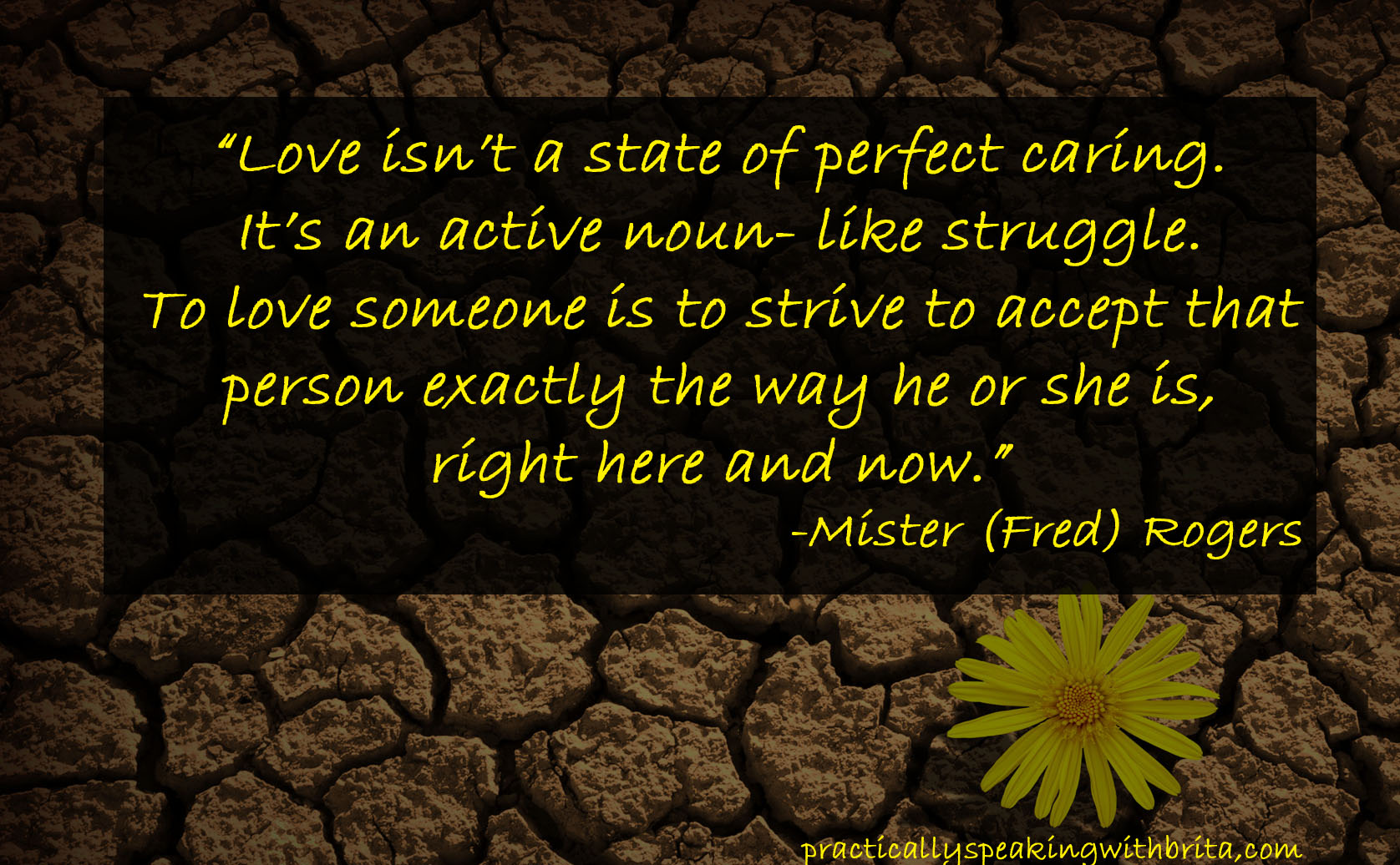
Tip #2: “Love isn’t a state of perfect caring. It’s an active noun- like struggle. To love someone is to strive to accept that person exactly the way he or she is, right here and now.”

I like you just the way you are does not imply that there is no room for change or growth. In fact, as Mister Roger explains, “I don’t think anyone can grow unless he’s loved exactly as he is now, appreciated for what he is rather than what he will be.” Love is the ingredient which allows for any and all positive attributes to flourish and grow.

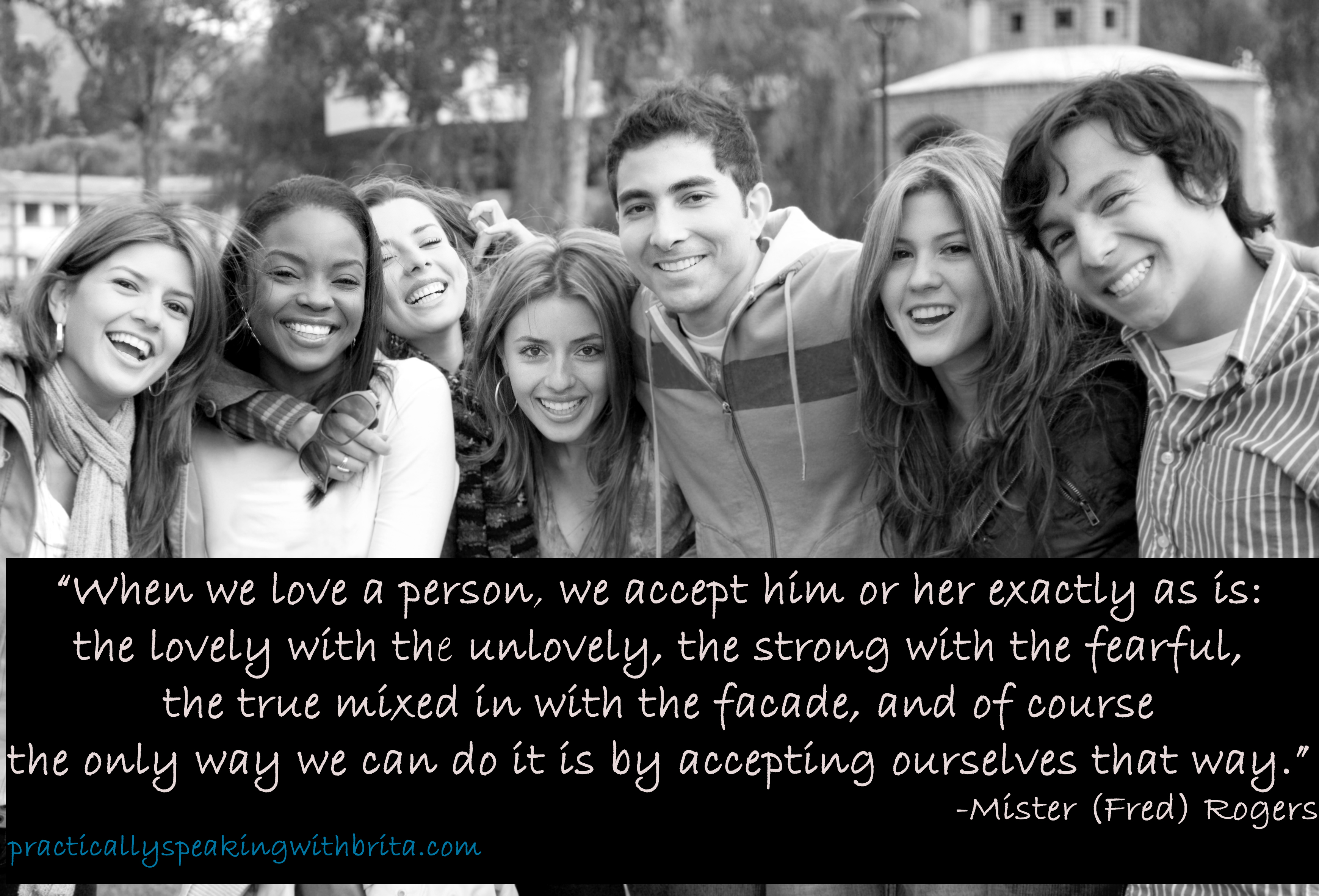
Tip #3: “When we love a person, we accept him or her exactly as is: the lovely with the unlovely, the strong with the fearful, the true mixed in with the facade, and of course the only way we can do it is by accepting ourselves that way.”

Recognizing and accepting our own strengths and shortcomings allows us to appreciate and accept that the humanness of everyone else and to truly love them. Mister Rogers noted, “What interests me so much about the characters of the Bible is that they make mistakes but God uses them anyways, in important ways. Nobody is perfect, but God can even use our imperfections.”

Mister Rogers’ wisdom about love cannot be understated. Today’s Tuesday Tip is an exercise developed by Mister Rogers that within one minute will enhance your gratitude and cultivate the love that you feel.

Mister Rogers was an advocate for what he called the silent minute. During this minute he would ask that you think about those who have helped you become who you are today. Whether they were near or far away or even in heaven, if they’ve loved you and encouraged you and wanted what was best in life for you he asked that you honor them and devote some thoughts to them during one silent minute. Imagine how grateful they must be that during your silent times you remember how important they are to you.

Try the silent minute exercise and see if your gratitude and love increase. Those 60 seconds can easily end up being your favorite part of your day. In the words of the infamous guru of childhood programing:


Truth or Myth: Connection is the Strongest Predictor of Happiness

Truth! According to a recent survey asking participants what their most important life goals were, 80% responded that a major life goal for them was to get rich. However, studies have found that close connection is the strongest predictor of happiness, much more so than making a lot of money or winning the lottery!

“Close connection significantly lessens susceptibility to anxiety and depression and makes us more resilient against stress and trauma” (Dr. Sue Johnson, Love Sense).

According to University of Utah professor, Dr. Bert Uchino, PhD, “a good relationship is the most powerful antidote to aging and the single best recipe for good health.” We are actually happier and healthier when we are close and connected.

According to the longest study on happiness, (The Harvard Study of Adult Development) which has tracked 724 participants for over 80 years, the clearest message that the study has revealed is that good relationships keep us happier and healthier.

So while many of our goals are centered around working harder, achieving more, making more money–going after those things as an attempt to have a good life– it is important to remember that it is actually our healthy relationships and our connections that have been scientifically proven to predict the greatest happiness.

Are you looking for ways to improve your relationships and connections? Check out proven tips and strategies here. Practically speaking, stay connected and stay happy!

5 Simple Steps to Change Negative Thinking

Truly the greatest battles are fought on the battlegrounds within our minds. A question that I often asked clients really showcased this. Imagine the thoughts that you told yourself yesterday were actually heard by the walls of your house. What color would the walls be? It probably won’t shock many of you to know that ‘black’ was a common response.

So, how can we change negative thinking?

These are simplified tips, but they really do work. I should note though that this requires teaching yourself something new and retraining how you think which is a process so don’t get discouraged if this takes time. You do not need to be perfect at it, but the more consistent you are, the easier it gets and the less mental exertion it requires to create the new neural pathway or way of thinking.

The thoughts that we think about ourselves have the greatest influence on how we react to the world.

Our brains are filled with neural pathways or basically paths or hiking trails in our brains. The more we follow a train of thought, the more we create that path and the grass gets trodden down and the trail becomes more ingrained.  What you focus on with your thoughts and feelings strengthens the neural pathways in our brains. Our brains are wired to follow the path of least resistance or the trail that has been traveled the most.

Recent research led by a team at the University of College London published 10 years ago has shown that the average time to develop new habits is 66 days. This study shows some important things to note: One, the amount of time each participants in that study took to develop a new habit highly varied (from 18 -254 days).  We are all wired differently so how long it takes for us to form a new habit will depend on each unique individual.  But most important thing to note that this study showed was that, while the time varied, ALL were able to create the new habit.

So, what are the five simplified tips to change negative thinking?

One. You need to make a conscious goal of what you want to change. Mentally state to yourself what you desire to change. Researchers at Harvard, Yale, and MIT have discovered that meditation (or prayer) increases gray matter in the prefrontal cortex which helps shift the body from the stress response to the relaxation response. Meditation (Prayer) is the highest form of mental training that disciplines the mind to focus on what you want and allows the nervous system to create a state of calmness or homeostasis. Mindfulness is powerful in creating change.

Label it and Mentally Say: “Stop!”

Two. When you begin to have a negative thought, you need to label it in your mind as such and mentally stay “Stop!” Having a label such as “This is not helpful thinking” or “That is harmful” or “This leads to feelings that make me feel bad” allows your brain to create an aversion to the formerly easy way of thinking that it has gotten used to.

Three. Give your brain a task to think of instead. Think what your best friend would tell you (“I am a fixer of mistakes. I can do hard things. I matter. You are in essense building a new neural pathway in your brain or a new way of thinking.

Four. Focus on the results that you want. “I want to be a happier person. I want to be a better mother.” Find an action that would give you those results. (ie smiling, acts of kindness or service.) No act, in the right direction, no matter how small, is ever wasted.

Five. Repeat, Practice, Repeat. Neural pathways are strengthened into habits through the repetition and practice of thinking, feeling and acting. Keep going. It will get easier.

Practically speaking, “Be kind to everyone-including and starting with yourself.” -Brita

9 Proven Strategies to Change Your Thoughts and Change Your World

You can transform your world in an instant by the way in which you choose to see it.

Our thoughts are more powerful than we realize. In fact, it is really not the events in our lives that cause us the most difficulty, but our thoughts about those events.

For example:

The Event: My husband is late home from work.

My thought: Great, I have more time to finish picking up the house before he gets here.

How do I feel? Maybe relief, excitement?

What is my behavior? Quickly use that adrenaline to go and pick up the house.

Now, look how much changes with a different thought.

My thought: He’s never been this late before without calling. What if he has been in an accident?

How do I feel? Maybe anxiety, worry and stress?

What is my behavior? Try calling his cell phone.

Our thoughts about an event are going to determine our feelings and the actions we choose are based on those thoughts and feelings. Even more astonishing is that the fact that for all of us, many times our thoughts are actually wrong. Our thoughts can become the cause of unnecessary confusion and pain.

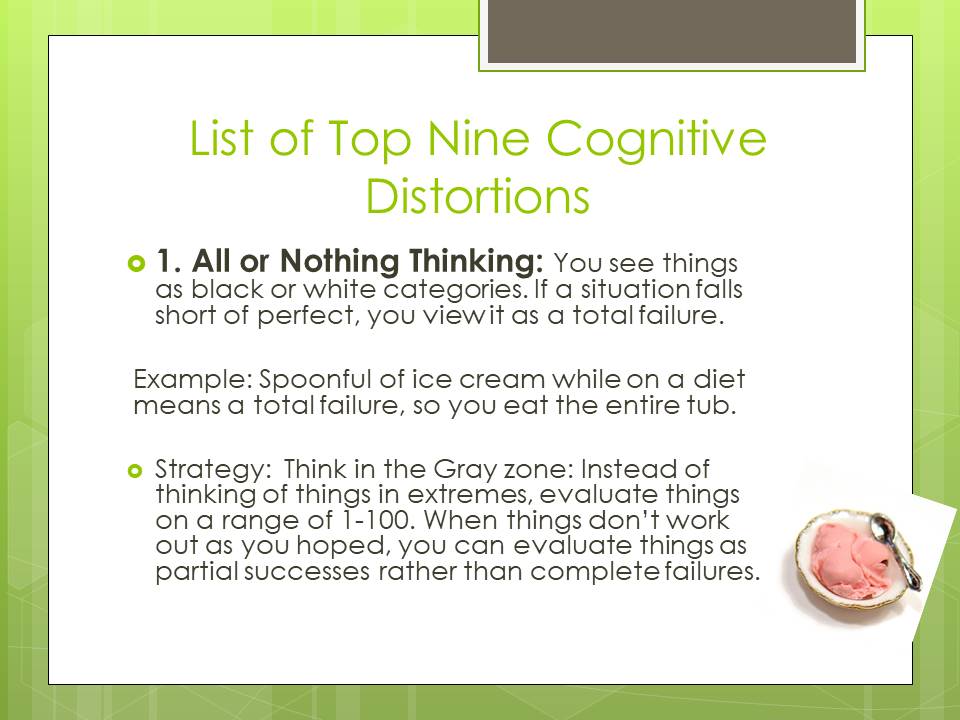
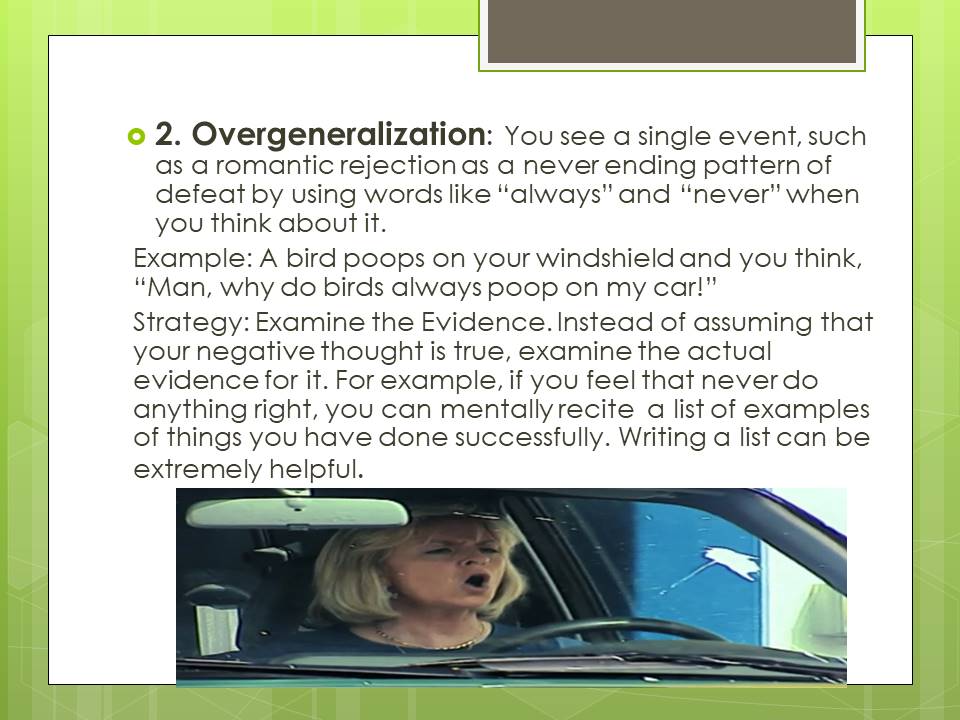
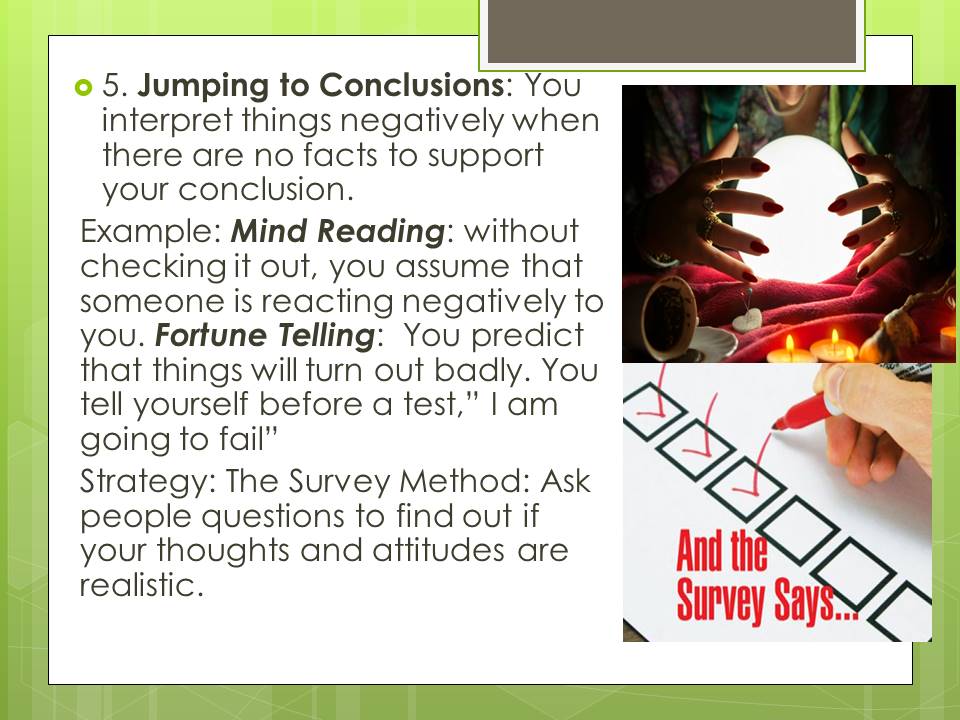
In the therapy world, these inaccurate thoughts are termed ‘Cognitive Distortions’ and everyone experiences them to some degree. Cognitive distortions are simply ways that our minds distort reality and convince us of something that isn’t really true.

While there are a myriad of cognitive distortions, below you will find my list of the top 9 cognitive distortions and more importantly the individual strategies to be able to address them.

How to Find a Good Therapist: Five Tips to Finding the Right Therapist For You

Question: I’m looking into finding a therapist. How do I find a good therapist?

Research over the past 60 years has demonstrated that there is one factor—more than any other—that is associated with successful therapy: the quality of the relationship between the client and the therapist.

Sadly, the mental health field is saturated with therapists, and like most professions, there are therapists that are good and those that are not.

Finding the right therapist is a daunting task especially when you are entering into a world you are unfamiliar with.  So how do you find a good therapist and how do you know if they are a good fit for you? There are a few good tips for finding a good therapist.

Tip #1: Know that it might take more time to find the therapist that is right for you. Similar to the advice from the weatherman during a winter storm advisory, (or the advice from a traffic report) it is helpful to remember to plan ahead and give yourself more time to reach your destination– in this case more time to find the right therapist for you.  Although it is difficult to be patient when you or a loved one are in the angst of making the decision to seek out a therapist, it is worth finding a good therapist and is essential for success. Getting an appointment can take time. Many good therapists have wait lists-which can actually be a positive indicator. Therapists with a high client turn over (an indicator they are not very good) often have more appointments available, so know that patience might be required.

Tip #2: Reach out to trusted friends and family members for referrals. Anyone who has completed or started their journey in mental health has had to begin walking the same path in finding a therapist. Their recommendations for therapists can be a useful starting point as you can learn from their experiences (positive or negative) and can help lead you to find a therapist that is right for your situation.

Tip #3: Online Research. All therapists should have an online bio which will tell you several  key pieces of information.

First, it will tell you their gender, which can be a determining factor for a good fit for you. Although this may not be a factor for everyone, some people feel more comfortable discussing their thoughts and feelings with a particular gender.

Another thing you can learn from their bio is their education. Where did the therapist go to school? While the best schools don’t necessarily make for the best therapists, you are going to want to make sure they went to an accredited school and not an online coaching certificate. You will want to know that they have invested in their education, as you will be the beneficiary of that investment.

The online bio will also tell you whether or not they are licensed. If they are an associate, (an intern who has graduated with their required educational requirements and is working on hours towards their licensure), that doesn’t mean you should discount them. The benefit of working with an intern or associate is that they would need to be working under their supervisor’s license and so you would be getting a potential two for one deal. If they do not disclose that they are an associate, or what being an associate means, then that is a good indicator that you should continue your search to find a therapist. Honesty is key in a working therapeutic relationship.

You should also be able to find online information regarding cost. When it comes to therapy, there is no set industry standard. The cost of therapy can vary widely depending on a number of factors including experience, level of education, degree of expertise and specialized training. The average session is between $80-$150 per 50 minute session.  Some therapists will work with a sliding scale fee schedule, which means their fee will depend on your income level. You cannot take cost out of the equation, but it also is not the best idea to bargain shop for your mental health.

If you would like to use your insurance to help cover the cost of therapy you are going to want to make sure you consult with your insurance. Insurance companies will often have a list of in network therapists for you to select from.  While the coverage with each insurance plan varies, the industry standard is between 6 and 8 sessions. Some other factors to consider if you are going through insurance is that the insurance will require information including a ‘covered’ diagnosis to be shared by your therapist with your insurance. Some insurance companies will also only provide coverage if a certain modality is used, such as cognitive behavioral therapy. 

Finally, the online bio will also tell you about their training, experience, specialities, additional certifications and their modality or their method of therapy. The more you know about what you are looking for in your personal journey, the easier it will be for you to identify therapists with the experience and training that will most help you. Seek out a specialist in that area where possible.

Tip #4 : Call for a Consultation. After evaluating the information you found online, the final key step in finding a good therapist would be to call and consult with the therapist. Consultations are free and are a great way of being able to get a sense of whether or not they would be a good fit for you. Share a little about your presenting issue and see how the therapist responds. Have they worked with anyone else with similar issues? If after consulting with the therapist you do not think it will be a good fit for you and your situation, you can always ask them for a referral for someone they would recommend to address your specific issues.  I often would refer out to other colleagues that would better meet their needs.

Tip #5: Trust Your Feelings. Searching for the key information online and consulting with potential therapists are key steps in finding a good therapist, but how can you know if you have found the right therapist fit for you?  The key to knowing if you have aligned with someone who can assist you in your journey really is a feeling that only you can recognize during your first couple sessions. It is not that you feel necessarily feel comfortable- therapy can often bring up uncomfortable feelings- but you should feel safe to be able to share your thoughts and feelings in a place that you can process them. Do you feel heard when you speak? Do you feel like they are invested in you? Do you feel like they have a plan that meets your goals?  The latest research indicates that this feeling, called ‘joining’ in the mental health world, should occur by the third session but the feelings often start during the second and can begin during the first session.  If you do not feel this by the 3rd session, you should seek a different therapist as this is not likely to be the right fit for you.

Balance Is Not Something You Just Find, But Something You Can Create.

Whether you are seeking small changes or searching for big miracles, the proven tips and strategies you find here can help you improve the way you think and feel about yourself and help create the quality relationships that we all want and need.

“Tuesday Tips” are designed to be practical, shareable tips with explanations to how they can impact and improve your emotional health and relationships.

Truth or Myth? These posts shared on Thursdays are designed to provide practical points to ponder and help provide psychoeducation to truths and myths about all aspects of emotional health.

Do you have a question that you would like answered by a licensed marriage and family therapist? Feel free to contact me with your question. Your question may provide the answers that will benefit others as well and all responses will be posted without any identifying information. Answers to questions asked can be found here.

Regardless of where you are in your personal journey, welcome! I hope that the practical, proven tips, strategies and answers you find here will help you on your journey to create the balance we all need. Practically speaking, “What you do today can improve all of your tomorrows.” (Ralph Marston)

-Brita